


'%20stroke-width='10'%20fill='none'%20/%3e%3c!--%20Right%20oval%20--%3e%3cellipse%20cx='148'%20cy='80'%20rx='76'%20ry='50'%20stroke='url(%23rightGrad)'%20stroke-width='10'%20fill='none'%20/%3e%3c!--%20Inner%20circle%20--%3e%3ccircle%20cx='128'%20cy='80'%20r='28'%20stroke='url(%23circleGrad)'%20stroke-width='8'%20fill='none'%20/%3e%3c/svg%3e)
STEREO READER
Parallel-view reader and eye trainer
Parallel view is a way of looking at two side-by-side images so that each eye looks at its own image. Your brain then combines them into a single picture, often with a clear sense of depth.
It is commonly used to view stereo images and 3D pictures without any special glasses. At first it can feel unusual, but once you learn the technique, holding the parallel-view position becomes much easier.
Parallel view opens
a whole new world
of ways to use your vision.
It is not limited to looking at 3D pictures - the same basic technique can also be used for longer and more active visual tasks.
Cross view is the opposite way of viewing stereo images: instead of looking with parallel visual axes, the eyes converge so that the lines of sight cross at a point between the eyes and the screen, allowing the left eye to view the right image and the right eye to view the left image. Because this mode deliberately increases convergence and keeps the visual system working in a stronger near-oriented configuration, it may be relevant for presbyopia and other difficulties with near focusing. Stereo Reader can also be used for cross-view training, including convergence practice and presbyopia-oriented visual exercises, using the same adjustable reading and fusion techniques.
Stereo Reader began as a parallel-view reader designed to train divergence and voluntary focusing. Since then, it has evolved into a much more comprehensive visual eye-training environment, supporting programmable exercises across a wider range of eye movements and extraocular-muscle work.
Modulations continuously change one or more visual parameters according to programmable curves. They can control divergence, rotation, counter-rotation, horizontal and vertical movement, blur, and other parameters, with adjustable amplitude, timing, speed, and motion curves.
Several parameters can be modulated together, allowing Stereo Reader to create coordinated movement patterns for divergence, cyclovergence, cycloversion, vertical and horizontal movements, and combinations of these movements.
Instead of consciously controlling individual eye muscles, the user simply follows the changing visual stimulus while Stereo Reader provides the movement.
Trainings combine multiple modulations into a timed training session. Individual modulations can be arranged on a timeline, repeated, alternated, or combined into longer movement sequences.
Trainings can also gradually change additional parameters throughout the session, allowing the exercise to progress continuously rather than switching only between fixed states.
This makes it possible to build complete eye-training routines that work different movement patterns in sequence while keeping the exercise automatic and reproducible.
The goal is to improve eye-muscle flexibility, coordination, and usable movement range through regular, repeatable sessions.
In my own experience, one or two 10–20 minute training sessions per day provide substantial eye-muscle work without requiring long periods of effort-intensive stereo reading. Since I started doing these training sessions every day, I have seen a major improvement in my Functional Vision Sharpness.
Stereo reading remains an important training method, but programmable modulations and training timelines now provide the most direct and flexible eye-training system in Stereo Reader.
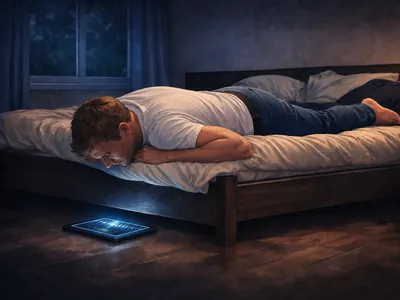
For the strongest training effect, I recommend doing Stereo Reader sessions lying face down and looking at a tablet placed below you. First fuse the stereo pair, then try to keep the image fused while keeping the eyes as relaxed as possible. Do not force the movement or strain to hold the image. Instead, allow the eyes to move outward gradually while maintaining fusion.
This position appears to make deeper divergence easier. In practice, the goal is to increase the comfortable stereo separation — the distance between the two images that can still be fused without excessive effort. In my own experiments, and in reports from other users, the maximum comfortable separation in this position can increase substantially, in some cases approaching twice the range achievable in a conventional upright position.
Within the mechanical model behind Stereo Reader, this provides a stronger stretch of the convergence-dominant eye-muscle configuration and allows a greater outward range of movement. The important part is not to push hard, but to maintain fusion with relaxed eyes and let the range increase gradually.
Your Files Stay on Your Device
Files added to Stereo Reader are stored locally in your browser. They are not uploaded to a server or transmitted over the network, so your documents remain private on your device.
Stereo Reader lets you keep a parallel-view eye position while reading normal text. Each eye follows its own copy of the text, and your brain combines the two into one readable view.
During ordinary close-up reading, both eyes stay turned inward for long periods. This keeps the inner eye muscles - the medial rectus muscles - working almost constantly and gives the eyes very little practice moving the other way. Over time, this convergence-heavy habit can reduce the eyes’ ability to diverge and may contribute to temporary distance blur after near work. Within the Stereo Reader approach, repeating this pattern for years may also contribute to more persistent problems with distance focusing.
Parallel-view reading changes that balance. It reduces the constant load on the inner eye muscles and gives the outward-moving muscles more work to do. Used regularly, it can serve both as prevention against convergence-heavy visual habits and as training intended to improve functional distance vision over time in people with myopia.
The main idea is simple: keep reading useful or enjoyable content, but give your eyes a different type of work while you do it.
Being myopic (-4.5d), in 2023 I started doing simple eye exercises for 5–10 minutes before falling asleep. Since then, my vision improved to some degree, which I considered worth sharing, so I created a YouTube channel in Russian to share my experience. By that time, due to regular exercises, I had acquired pretty good eye muscle sensitivity, so I could feel which eye muscles contract and relax, given that I had learned eye muscle anatomy in detail. This allowed me to develop my own precise view of what causes myopia. This is a logical continuation of the Bates method.
Regardless of the mainstream consensus that it is false, the main idea — that coarse focusing is done by extraocular muscles and final focusing by the eye lens and thus training those muscles can improve vision — allowed many people who shared their experiences with me to improve their functional vision sharpness.
My experience suggested that myopia happens due to shortening of the eye rectus muscles, especially the medial ones (internal, near the nose), which converge the eyes for near focusing. In July 2025, I began stereo reading—reading text in two columns in parallel view—where the eyes diverge to the point of exotropia, a state in which the eyes diverge beyond parallel alignment. I also found that my myopic audience has very poor ability to diverge and achieve any significant exotropia, whereas people without myopia have strong exotropia ability. Since then, exotropia and stereo reading have become my main tools for training my eyes. Reading alone is used in many vision improvement systems, including Bates’.
Here are my results in usual text reading, in non-stereo mode, since reading in stereo reduces ability to focus. This does not mean that I see the text clearly, some effort is needed. However, the progress described here clearly corresponds to my everyday visual experience.
In June 2025, I started out being able to read 2 mm lowercase letters from a distance of 33 cm.
By September, I had achieved a 3x improvement in angular size and started reading at a 3-meter distance with 2 cm lowercase letters. The angular resolution improvement from near vision did not transfer directly to distance vision, so in practice I started distance reading at a lower resolution. I suspect that my distance resolution had been even lower when I started the experiment, since my everyday distance vision had already improved by the time I began reading at 3 meters.
Now, in May 2026, I can read 3.7 mm lowercase letters from 3 m, which corresponds to about a minimal
5x
improvement in my distance vision.
As a practical result, I was able to stop using glasses for everyday activities. This includes watching TV and movies, going to the cinema, visiting stores, shopping, walking outside, and performing essentially all normal daily tasks. I can also drive without glasses in daytime conditions. The only situation where I still use glasses is nighttime driving.
Given other users’ experiences, I am currently strongly convinced that eye muscle exercises can be a working tool for improving functional vision sharpness.
To make this method practical, I started developing Stereo Reader — an application designed to facilitate reading in parallel-view stereo mode.
Stereo Reader allows books and documents to be displayed as two synchronized text columns, one for each eye. The distance between the columns can be adjusted, allowing the user to control the amount of divergence, up to a strong parallel-view / exotropic mode. The font size, column spacing, reading distance, and other parameters can also be adjusted.
The application supports various e-book and document formats, including EPUB, PDF, plain text, and FB2. It can be used not only for fiction, but also for technical literature, documentation, and other long-form reading materials.
Stereo Reader also supports voice commands and mouse control, which makes it possible to read from a computer monitor, TV, or other distant screen without constant direct interaction with the device. For example, pages can be turned with a wireless mouse, and reading sessions can be controlled by voice. The application also includes a session timer, so the user can set a reading duration, such as 20 minutes, and receive a notification when the session is finished.
In addition to text reading, Stereo Reader can open images and stereo pairs. The user can adjust the distance between the left and right parts of a stereo image and use them for parallel-view exercises. This makes it possible to train not only with text, but also with stereoscopic images and different types of stereo-fusion tasks.
The main practical advantage is that eye training can be combined with useful or enjoyable reading. Instead of treating training as a separate repetitive exercise, I can read something interesting, such as Isaac Asimov’s Foundation, while simultaneously performing the visual task. The same applies to technical PDFs or other educational materials: reading itself becomes the training session.
The application can also be used as a regular remote-controlled reader for reading from a large screen at a greater distance. This may be useful even outside of active training, because it allows reading without strong near convergence and without holding a phone close to the eyes.
Before using Stereo Reader, it is useful to first understand parallel-view stereoscopy. In parallel viewing, the left image is viewed by the left eye and the right image by the right eye; the viewer relaxes convergence and looks “through” the image until the two views fuse into a single stereoscopic image. Free-viewing tutorials and stereo-image galleries can be used for initial practice before trying stereo reading.
A good starting point is to practice with ordinary stereoscopic image pairs first, then move to Stereo Reader after the basic parallel-view fusion skill becomes familiar. Stereo image galleries such as Hidden 3D or Stereoscopy.com provide examples available in both parallel-view and cross-view formats.
My personal goal is to improve my vision by next summer to approximately the level I previously had when wearing -3.5 glasses.
Those glasses did not give me full correction, but they gave me enough functional sharpness to drive at night, including on roads without street lighting. I avoided full correction because, in my own experience, wearing fully corrective glasses made my vision worse over time. For that reason, I used weaker -3.5 glasses instead.
So my personal target is clear: by next summer, I want to reach the level of vision that previously required -3.5 glasses.
My second goal is to continue improving Stereo Reader based on user feedback and real usage.
The application already allows reading in stereo mode, adjusting divergence, changing font size, reading from different distances, opening e-books and documents, using voice commands, controlling reading with a mouse, setting reading timers, and working with stereo images.
The long-term plan is to extend it further and introduce more types of visual stimuli in exotropic / parallel-view mode. Possible future directions include stereo mode for ordinary videos, converting regular images into stereo images, generating stereo images, and adding more exercise modes.
The goal is not just to make a reader, but to create a flexible visual-training environment where text, images, video, and interactive elements can all be used as training material.
My third goal is to expand the audience around this method.
I want to share the approach with more people, collect more feedback, improve the method based on real experiences, and gather more practical evidence from users who try it. For me, this has become a small personal mission: to bring this idea to a wider audience and give people another tool for improving functional vision sharpness.
Vision has a major effect on quality of life. Even partial improvement can make everyday activities more comfortable: reading, walking outside, watching TV, driving, working with screens, and simply perceiving the surrounding world with more detail.
A key part of this mission is to challenge the pessimism around eye-muscle training. The idea that training the extraocular muscles can improve functional vision sharpness is not supported by mainstream medical consensus, but my own experience and the experiences shared by other users suggest that compensatory mechanisms may be much stronger than commonly assumed.
I am especially interested in developing this method as a practical, measurable, user-driven approach. The goal is not to make abstract claims, but to create exercises, tools, and protocols that people can test in their own visual experience and report their results.
In addition, regular eye-muscle activity may have broader functional benefits. Like other muscles, the extraocular muscles may benefit from training, coordination work, and controlled loading. Improving eye-muscle fitness may also support better local circulation and a healthier functional state of the visual system. This is one of the reasons I consider this direction worth exploring further.
The Bates method did not fully fail. In my opinion, its main limitation was that it emphasized relaxation too much, while the more important mechanism may be eye-muscle stretching and active training.
When muscles remain under chronic tension, they can lose flexibility and become functionally shortened. People who train in the gym know that strong or chronically loaded muscles often need deliberate stretching. If certain back, hip, or leg muscles are constantly tense, flexibility decreases. I think a similar principle may apply to the extraocular muscles.
From this perspective, relaxation alone may be too weak, especially in long-term or more severe cases. If the problem involves chronic shortening, imbalance, or reduced flexibility of the eye muscles, then simply trying to relax the eyes may not be enough. The muscles may need targeted stretching and controlled loading.
This may explain why the Bates method produces inconsistent results. Some people report improvement, especially in mild cases, but often this requires major changes in visual habits, such as spending one or two hours every day looking into the distance. In such cases, it is difficult to separate the Bates method itself from the broader lifestyle change.
To be fair, Bates did not only use relaxation. He also used active visual tasks, including reading text at a distance and reducing the size of the text over time. In that sense, text recognition under visual difficulty was already part of his system. He also treated his theory seriously enough to perform mechanical and physiological experiments, including experiments intended to study the role of the extraocular muscles in accommodation. So I do not see Bates as an unserious figure. I see him as an important historical figure in alternative vision training.
However, in my view, his practical method was not specific or strong enough. The active reading component existed, but it was not developed into a precise progressive training system. The reported results were also not clear or standardized enough to make the method reliably reproducible.
My approach uses a similar basic principle — recognizing text at the limit of readability — but applies it in exotropic / parallel-view mode. This changes the mechanical task. Instead of only trying to relax the eyes, stereo reading forces the visual system to work while the eyes are diverged. In my interpretation, this directly targets the imbalance associated with excessive convergence: it stretches the medial rectus muscles and strengthens the lateral rectus muscles.
So the difference is not just “reading text.” The difference is reading text while deliberately training divergence and visual recognition under that muscular state. The goal is to restore balance, increase exotropic capacity, and then learn to recognize distant objects and text under that improved muscular configuration.
There may also be strong individual variability. Some people may have more flexible muscles, softer connective tissue, different visual habits, or a shorter history of focusing problems. For them, relaxation-based exercises may be enough. Others may have much stiffer muscles and a longer history of visual imbalance. For them, “just relax” may not work.
This is similar to general flexibility training. Some people can learn to do a split relatively quickly. Others have stiff muscles, rigid connective tissue, or anatomical limitations, and need much more direct work. The same may apply to the eye-muscle system.
There may also be anatomical variability in the extraocular muscles themselves: their length, attachment angles, leverage, and mechanical balance may differ between individuals. In bodybuilding, this kind of anatomical variability is obvious: different people have different muscle insertions, limb proportions, and mechanical advantages. It is reasonable to assume that similar variability can exist in the eye-muscle system as well.
So, in my view, the Bates method has limited applicability. It may help some people, especially in mild or recent cases, but it is not strong or specific enough for everyone. I personally tried Bates-style relaxation exercises several times during my life, including periods when I practiced them seriously, but they did not give me meaningful results.
For me, stereo reading and exotropic training produced much stronger results than Bates-style relaxation. It also produced positive feedback from other users. For that reason, I chose to focus on Stereo Reader and parallel-view training as the main practical direction.
People who want to study the Bates method can still do so. It may have therapeutic value for some users. But in my opinion, its limitations should be recognized: relaxation alone is often not enough. In more difficult cases, real training may be required.
I do not make any medical claims on this website. The method described here is not presented as a medical treatment, medical advice, or a guaranteed way to cure any diagnosed condition. My focus is
Functional Vision Sharpness
‐ the practical ability to focus, read, and use vision more effectively in everyday life. The word “correct” in this project’s context does not mean “permanently cure.” It means improving functional visual performance through training, while recognizing that the original tendency toward poor focusing may remain.
Even when a person achieves significant improvement, I do not claim that the result will necessarily be permanent without maintenance. If the visual habits that contributed to the original deterioration remain unchanged — prolonged near work, excessive screen use, poor visual breaks, and lack of distance focusing — then stopping the exercises may gradually allow vision to regress. In this sense, eye training is closer to fitness, yoga, or strength training: it may require consistency, maintenance, and long-term changes in habits.
These exercises should be approached as real physical training for the visual system. They can create strain in the extraocular muscles and the broader eye-focusing apparatus. Mild muscle-like soreness during eye movement on the next day may happen after intensive training, similar to soreness after physical exercise. However, sharp eye pain, acute discomfort, visual disturbances, or any sensation that feels abnormal should be treated as a warning sign. In that case, the exercise should be stopped immediately, and training should not be resumed until the symptoms have fully resolved.
This method is intended only for people whose eyes are otherwise organically healthy. It is not intended for people with serious eye diseases, retinal problems, glaucoma, cataracts, vitreous detachment, degenerative eye changes, inflammation, recent eye surgery, trauma, or any condition where additional eye strain may be unsafe. If you have any known eye disease, unexplained symptoms, or doubts about whether this type of training is appropriate for you, consult an ophthalmologist before attempting the exercises.
There are different levels of intensity. A light approach, with low strain and careful avoidance of discomfort, may be suitable for modest improvement or stabilization. More significant results may require consistent training, sometimes 30–60 minutes per day, but this also creates much higher physical load on the eyes and increases the risk of overtraining. As with strength training, increasing intensity too quickly can lead to injury. Progress should be gradual, controlled, and based on clear feedback from the body.
Sporadic exercises are unlikely to produce substantial results. The method depends on consistency: regular training, attention to visual habits, and gradual adaptation. At the same time, even moderate and careful practice may still be useful for stabilizing functional vision sharpness, reducing further deterioration, or producing smaller improvements. The goal is not to ignore medical reality, but to train the functional capacity of the visual system in a way that improves quality of life.
Proceed carefully, avoid pain, respect recovery time, and treat this as serious physical training for the visual system rather than a quick medical cure.
Stereo Reader is currently in the early adoption phase for a wider audience. The method, the application, and the community are still developing, so feedback from real users is especially valuable.
The best way to start is to first understand the principle of parallel-view stereoscopy. Before trying stereo reading itself, it is useful to practice with simple stereo images and learn how to fuse two side-by-side images into one stable image. After that, you can try Stereo Reader and gradually experiment with text, distance, font size, and divergence.
You can join the project in several ways: